Jordan Barney
August 25, 2026


Every B2B revenue team shares content to win deals: decks sent the night before a call, the case study dropped into a follow-up, and the pricing one-pager a prospect pores over at 11pm.
But almost no team can tell you what that content actually did to move the deal. A prospect could read a case study six times or never open it a single time, and you may never know the difference.
This visibility gap is one of the most expensive blind spots in B2B.
Marketing can't prove which content moves revenue, so they keep guessing at what to make next. Sales can't see what a prospect has already read, so reps walk into calls half-blind and repeat themselves. The work closest to the deal is the work nobody can measure.
And if your team sends content to prospects, this blind spot is likely yours too.
Everflow sits unusually close to this problem because attribution is our entire product: we measure clicks, conversions, and commissions across thousands of partner relationships, down to the cent. Sharing a piece of content with a prospect is the same kind of event we measure for our customers: a link that gets clicked, and engagement that either gets captured or lost.
So when our CMO, Michael Cole, asked whether the content our sales team shared was helping us win deals, the answer should have been a click away. It wasn't.
Our deal content lived where most companies' content still does: inside a third-party document tool, outside the reach of our own tracking. So we did the obvious thing for a company that tracks everything and pointed our own product at the blind spot.
This is the story of what that revealed, who built it, and what any B2B revenue team can take from it.
You can count clicks on a blog post all day, but the content shared with prospects on live deals sits in its own black box. That's the content that could matter the most for winning the deal. For Everflow, the gap showed up as three failures:
That third failure is the spine of the story.

The sequence buried in that line matters more than it seems: make the right content effortless to share and reps use it without being told. Once they're using it, every share becomes a data point. Only then can you see what's working. The whole system depended on getting that sequence right, and on someone being able to build it.
The team didn't lack content; it had so much, scattered across so many browser tabs, Slack threads, and Drive folders, that excavating the right resource had quietly become its own job.
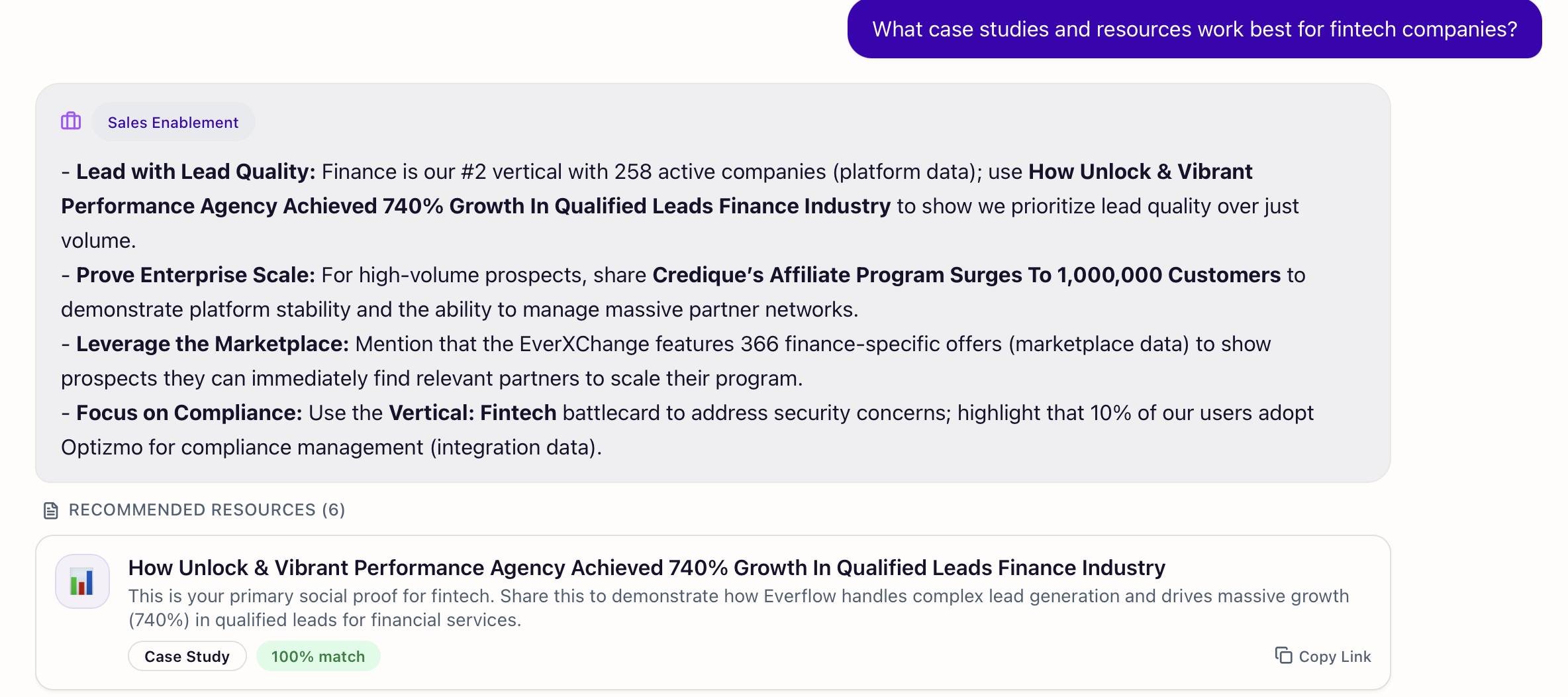
Dasha Shareyko, our Product Education Manager, had the diagnosis: "The problem was never that it wasn't there. It's that we were all too busy doing the work to go dig out the work." In September 2025, at a Product Marketing Summit, she watched a speaker wire up a working content pipeline on the AI tool Lovable and recognized the same approach would solve our problem. So she learned how to make Lovable build that pipeline, and 24 prompts later she had an internal wiki up and running.
The wiki solved findability, but it didn't stop there: it grew an analytics layer, and that layer started with a question Michael asked.
"What if every shared resource carried a tracking link, so we could see who actually used what?"
That question reached straight into Everflow's core product. The same attribution power our company provides, the one that follows a click all the way to a conversion, could be activated for Everflow's own content. That's how a simple internal wiki eventually became a prospect-intelligence system running on the exact infrastructure Everflow already builds for its customers.
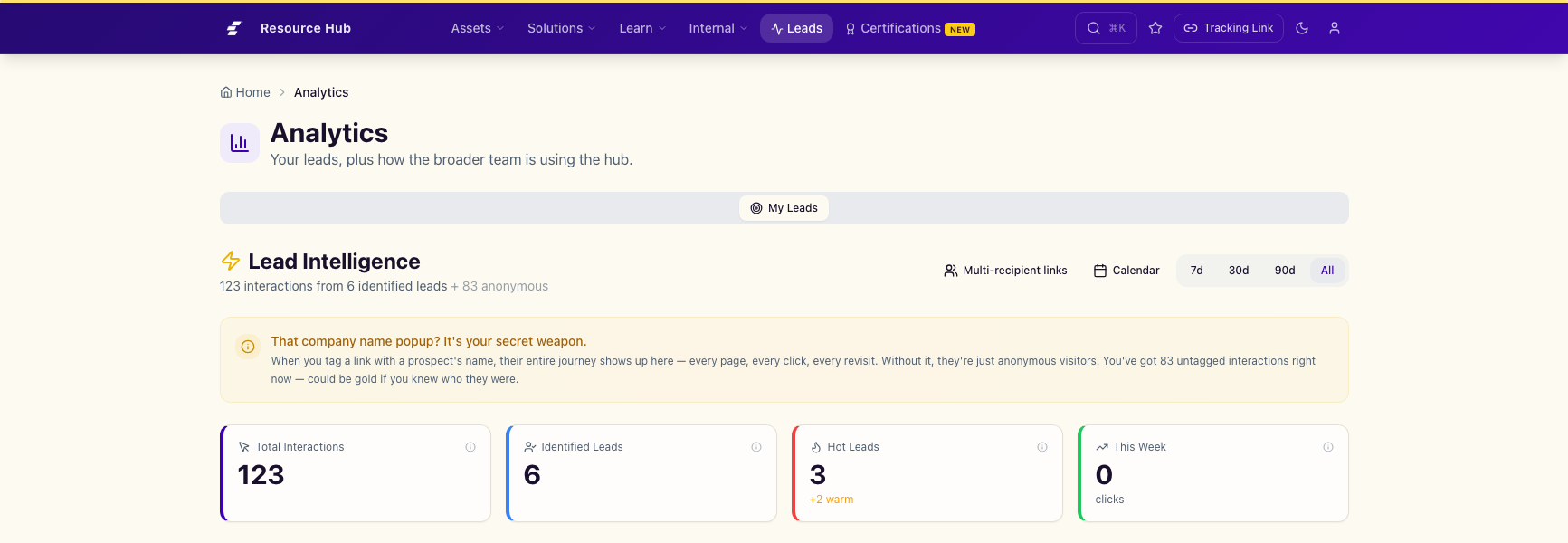
In March 2026, the team relaunched the wiki company-wide as the Resource Hub: 141 invite emails, an AI assistant, a Lead Tracker, PDF previews, its own domain. The distance between a rep and the right content was now a single click, and the distance between sharing a resource and knowing whether it landed was zero.
What the Hub does now is best understood by following a single share, from rep to prospect and back:
The prospect's identity isn't in the URL; it lives only in the rep's Lead Tracker, which means full visibility with no personal data riding in the link itself. And the rep didn't have to complicate their process as the easy path and the tracked path are now the same.
What that buys an account executive is a full rundown on any single deal. Pull up one account and it's all there in about a minute: every call summarized, every resource the prospect opened or didn't, and the moment they moved from polite to genuinely engaged.
Take one real account, anonymized: a health-and-beauty brand that first appeared in Everflow's HubSpot in late February. That same day, before anyone had spoken to them, they browsed through our website on their own: the Health & Beauty solutions page, the Everflow Pay product and pricing pages, and the marketplace directory. A discovery demo followed.
The demo didn't close them, but it started them reading. A week later they opened a customer case study, "740% Growth in Qualified Leads." Days after that they were back on the Everflow Pay pages and the eCommerce attribution page. Shortly after came two technical implementation calls working through Shopify, subscription tracking, and how their referral program would run.
By late April they were onboarding as a client, their Everflow Marketplace profile was approved and an expansion conversation opened: not just a signed deal, but a customer leaning in for more. An AE looking at that record doesn't have to guess where it turned. The demo planted the question, the case study and product pages answered it, and the second implementation call was where caution became commitment.

That journey did more than close a deal. It changed how our company works.
Tagging a share to a specific prospect had been possible for a while, but it mostly sat unused, just enough of a chore that reps skipped it. Dasha removed the friction, and once tagging became effortless and reps saw a real journey like this one laid out click by click, the value stopped being theoretical. It spread exactly the way Michael predicted, because the easy path finally showed its payoff.
That same record keeps working after the deal closes. An existing account lingering on the Everflow Pay pricing page now reads as an upsell raising its hand, where there used to be a void, and the customer's account manager sees it and knows what to bring to the next call.
And the Hub didn't stop at a Lead Tracker. It grew into the company's internal operating layer: an AI assistant that answers from the Hub's entire indexed library, customer timelines on live deal and call data, a help-desk article pipeline, a deck builder, and a tools directory that gives the team one place to find everything.
We didn’t have a "before" to measure against, but that’s exactly where the story begins: you can’t show a lift when you're starting from zero.
What you can show is everything the team can suddenly see. "The moment the data proves a hunch, or kills one, it goes from zero to a hundred fast," Dasha says.
Let's start with the footprint the Hub built in just a few months:
But the number that matters most isn't reach: it's revenue the team can finally measure. Prospect-level tagging is only a few months old, and most shares still go out untagged, so what follows is only a sliver of the full picture.
Even from that sliver, the Hub has already followed 46 named companies through their content journeys. Among them: 5 signed, worth about $7,000 a month in recurring revenue; 15 open opportunities representing roughly $33,000 in total pipeline; and 14 more in active nurture.
Every untagged share could be hiding a deal Everflow can't yet see, which means every figure here is a floor.
No one is claiming the Hub closed those deals on its own. What's new is that, for the first time, Everflow can see the whole story and act on it.
And what the Hub surfaces is richer than a list of closed deals.
In a single view, a rep can watch a prospect move through HubSpot-classified deal stages on Everflow's own platform data and, right beside it, see exactly what content carried them: which one-pager, which ICP page, whether they wandered into the marketplace or studied an agency partner.
That's one screen answering two questions. How do we close deals like this one, so marketing can do more of what worked? And how do we serve this customer once they sign?
Visibility on the front of the funnel sharpens how Everflow sells and what it publishes. Visibility past the close turns onboarding into something the team can tailor instead of guess, and it spots the quiet early signs of churn. When an account that used to live in the Hub goes silent, that silence is now a signal the team can catch.
Maybe a resource caused a deal, maybe it didn't. You no longer have to wonder, because now you can see the whole story and do something with it.
The companies that stay competitive won't be the ones with the prettiest dashboards. They'll be the ones that know exactly what their data contains and can act on it, a kind of sovereignty over their own operations. Everflow built the proof of that on the hardest audience a product can face: its own team.

The same engine Everflow's customers use to attribute their revenue got pointed inward, and what came back was exactly what the platform promises everyone else: visibility where there had been none, and the standing to act on it.
The lesson here for any B2B leader is simple. Your data platform should work as hard for you internally as it does for your customers, or your most important intelligence stays trapped in tools that don't talk to each other.
The next version will wire the Hub's AI layer into Everflow's MCP server and merge its chat with Flowbie, our internal Slack agent. In that version, every link carries its ID automatically, every interaction feeds back into HubSpot, and the journey from first touch to closed deal is attributed end to end, with no one pulling a report.
That is the friction loop closing on itself: surface the right content, track every engagement, return clean attribution to the people who need it.