
Tripping at the Finish Line: How LTVX.ai Stops the Soft Declines Driving Your Top Affiliates Away


For performance marketers, the checkout button is supposed to be the ultimate finish line.
You spend weeks dialing in your landing pages, your affiliates are absolutely ripping traffic, and a highly motivated buyer finally clicks that "Buy Now" button. Total home run, right?
Not anymore. Right at the goal line, a massive chunk of those sales is quietly vanishing.
Chances are your native processor is routinely rejecting buyers with fully loaded credit cards. That’s because modern banking fraud filters are more aggressive than ever. Even minor triggers like rapid clicking or international locations cause automated "soft declines."
This setup is like a clueless nightclub bouncer who kicks out your highest-paying VIPs while you’re stuck in the dark. That’s why soft declines kill revenue and affiliate trust.
Affiliates risk their own ad budgets to send you traffic, so when your checkout eats their commissions, their earnings per click (EPC) plummet. Rather than wait and troubleshoot, they’ll simply pause your offers and transfer their traffic to a competitor that actually converts.
Stopping this leak requires an invisible backend safety net like LTVX.ai to rescue those failed sales without messing up your tracking. In this masterclass, we break down exactly how to audit your checkout for soft declines, reclaim your wasted ad spend, and secure the conversions your affiliates are fighting to send you.
Under the Hood: How Revenue Rescue Actually Happens with LTVX
Standard gateways are incredibly passive when a payment gets rejected.
They ask the bank for the money, get a refusal, and give up immediately.
But LTVX changes that by stepping in the exact millisecond a failure happens. Instead of letting the sale die, the system catches that failed payment entirely behind the scenes.
LTVX uses an in-house blueprint of 15,000+ card types called a BIN logic map. This map acts as an insider cheat sheet for banking behavior, showing exactly why a specific issuer blocked a card. Once the platform diagnoses the hurdle, it instantly swaps the routing details and pushes the payment through private tier-one global banking connections to find a path to approval.
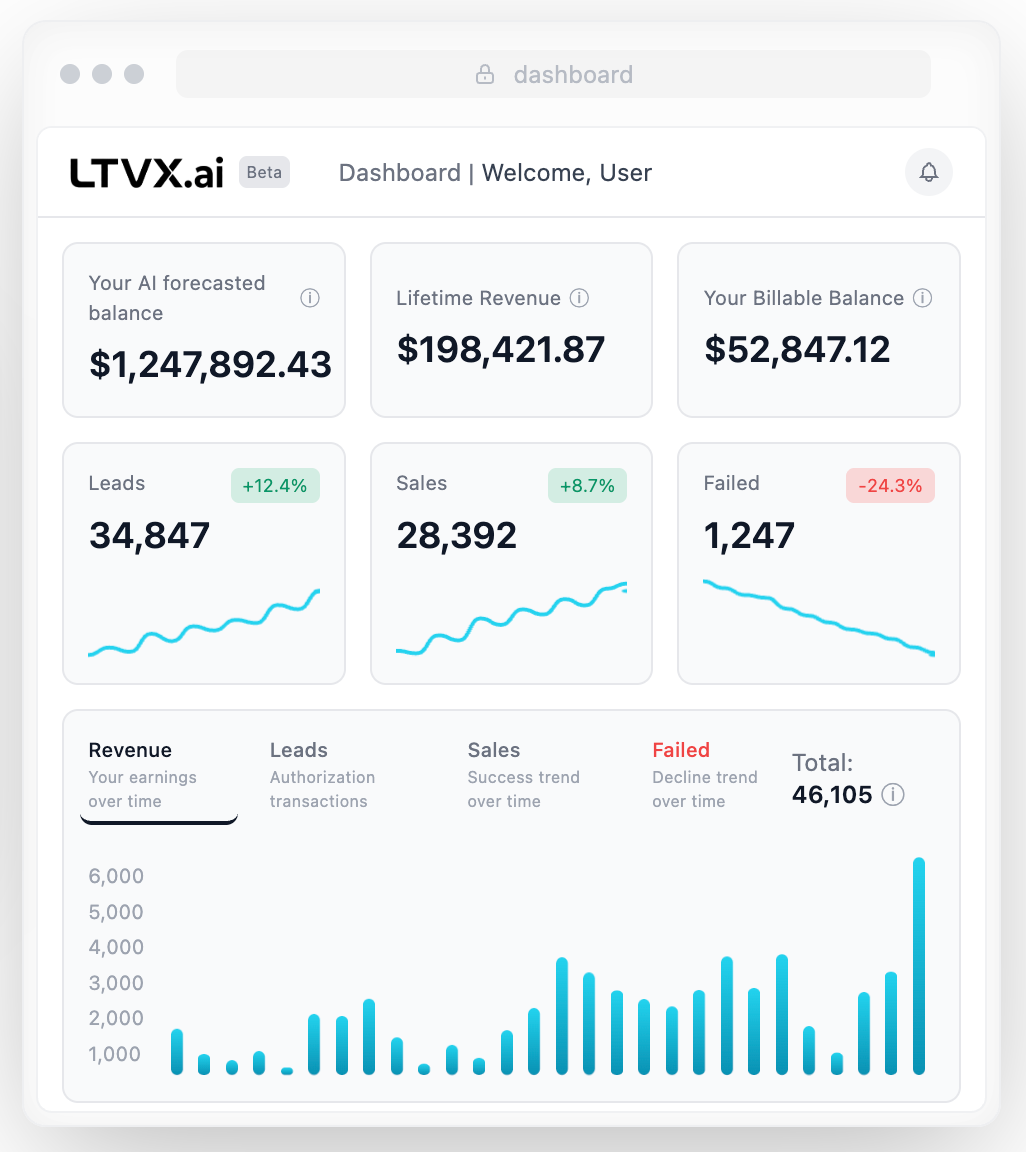
This entire sequence takes less than 30 seconds. Shoppers never see a glitch, a frozen screen, or a tacky pop-up trying to save the sale. Everything happens completely out of sight, turning a dead transaction into a conversion without forcing you to change a pixel on your checkout page.
Understanding this backend loop shows you how the rescue works, but fixing the leak for good means acknowledging the challenge that your checkout process is up against.
The Harsh Reality of Soft Declines
Traditional payment setups are built to do one job: push a transaction through.
When a customer hits your checkout page, standard gateways pass the card details to the issuing bank. If the bank's automated fraud scoring flags a minor variance, such as cross-border traffic patterns or quick transaction velocity, it triggers an immediate soft decline.
Matiss Maliks, Head of Sales and Growth at LTVX, notes the limitation of this traditional setup:
And so the transaction simply dies.
For brands scaling campaigns rapidly, this means that perfectly clean, revenue-generating traffic gets thrown out right alongside the actual fraud.
Given these banking filters are so unforgiving, most marketers have no idea they are losing revenue to this issue. Not to mention how to accurately look under the hood and diagnose it.
How to Diagnose (and Reclaim) Your Wasted Acquisition Spend
When a payment fails at checkout, the financial damage ripples far beyond a missed sale.
The immediate loss of top-line revenue is painful, but the deeper problem is your CAC. By the time a buyer reaches your checkout page, you’ve already footed the bill to build the offer, test the creative, and buy the traffic.
To protect your marketing spend, you need to shift from passive processing to active recovery.
Marketers can check for this problem using a quick diagnostic step recommended by Maliks: run a decline rate audit. Here's how:
- Pull your issuer response codes: Look directly at your checkout data to review the exact reasons behind your failed transactions.
- Flag generic errors: Scan your report for a high volume of vague response codes, such as "do not honor" or generic soft decline categories.
- Isolate the technical failures: If those specific codes make up a notable percentage of your rejections, you are dealing with automated bank friction rather than actual insufficient funds.
Identifying these specific codes takes less than fifteen minutes and gives your media buyers the exact data they need to optimize campaigns accurately. Pinpointing this leak is the first step toward not only reclaiming ad spend, but also protecting relationships with your top affiliates.
Sustaining the Affiliate Value Loop
Every rescued checkout conversion feeds a continuous loop of new traffic for your brand.
Remember: high-volume affiliates don't just sit on their payouts. They quickly reinvest their commissions straight back into buying more traffic.
To keep this loop spinning, your data continuity must remain flawless. If a payment platform rescues a sale but strips out the tracking data during the rerouting process, the affiliate still gets cheated out of their commission.
LTVX automatically preserves the original tracking details behind the scenes. Click IDs, subparameters, and attribution flows remain untouched, allowing every recovered conversion to log. This means your traffic partners always receive accurate credit. Providing this credit consistently builds trust and ultimately better relationships with your best affiliates.
Keeping Your Data Clean When Payments Move
Trying to patch together your own payment re-routing usually creates a massive tracking crisis.
The reality: traditional banking lanes don’t care about your marketing pixels. When a payment gets bounced around to find an approval, the technical handoffs usually wipe the affiliate trail completely clean. Your media buyers lose their data and your partners lose their commissions.
This data loss is why enterprise brands rely on dedicated payment recovery tools rather than trying to build their own. For example, LTVX handles this backend data mapping automatically. Their system ensures every single recovered conversion logs seamlessly inside your tracking platform (like Everflow!) without losing a single subparameter or click ID along the way.
Once you protect that data loop, the final piece of the puzzle is getting the system live without breaking your tech stack.
Plugging Revenue Leaks Without a Coding Overhaul
Most teams assume that fixing backend banking errors requires a massive engineering project.
In reality, setting up a recovery tool like LTVX is a light lift. You can connect to the platform via a simple API right on your checkout page without rewriting your codebase or distracting developers.
This safety net is especially important if you are an enterprise brand processing heavy volume. Consider an enterprise merchant pulling in $150 million in revenue per month. If that brand faces a standard 10% decline rate, they are looking at $15 million in failed transactions.
When you’re doing big numbers, tiny banking glitches quickly compound into massive amounts of lost cash. Meanwhile, trying to build a custom solution from scratch is a headache when you just need a dedicated tool to automate the rescue process.
The takeaway? Overcoming soft declines comes down to putting a smart layer of protection in place so aggressive banking filters never stand between your brand and the revenue you already earned.
Tools like LTVX handle all the heavy lifting behind the scenes so your media buyers can scale campaigns with confidence. While they salvage the sales, tracking platforms like Everflow keep your partner payouts perfectly aligned.
