
Stop Begging for Budget: How to Reclaim Trapped Ad Spend to Fund Your Performance Partnerships


Convincing a CFO to approve more budget for partner programs means jumping through hoops.
And that’s a major understatement for most affiliate and partnership managers.
You shouldn’t have to sink hours into hyper-detailed slide decks to check an administrative box or appease leadership. This exhausting approval cycle forces teams to beg for cash while media buyers scrounge for every last crumb of campaign efficiency.
The reality? The cash needed to scale your partnerships is likely already there. It’s just trapped.
Because for many high-growth programs, thousands of dollars are bleeding out of ad accounts due to junk traffic and corporate cards that aren't built for media buying.
Kurt Bell encounters this exact financial blind spot all the time. As the Director of Enterprise Sales at Dash.fi, Bell helps brands transform their basic financial workflows into a defense system that automatically recovers lost ad spend and maximizes cash-back margins.
His perspective highlights a glaring truth: most brands are completely unaware of how much money they leave on the table due to unoptimized payment processes. This Masterclass breaks down how to audit traffic leaks and maximize card rewards to win back your budget.
The Hidden Leaks Plaguing Paid Media Accounts
Every dollar wasted on bot traffic is a dollar stripped from an enterprise partner program.
Marketers spend cycles optimizing CAC and ROAS, but they rarely evaluate how they actually execute payments for their media. Paid channels are littered with transactional inefficiencies that slip past traditional accounting software. This leads to massive waste.
According to Bell, this waste typically stems from three major areas:
- Invalid traffic. Non-human bot interactions that exhaust campaign budgets without any real chance of conversion.
- Out-of-geo targeting errors. Clicks originating from locations outside of your designated parameters for which you are mistakenly charged.
- Phantom traffic (click spam). These are instances where bots or fake users immediately exit your site without staying long enough to constitute a legitimate visit.
Bell notes that Meta is notorious for these issues, as spam accounts and bots constantly flood comment sections, posts, and active ad placements. Meta has generated billions of dollars from invalid traffic over the years, proving that platforms profit heavily off advertiser waste.
Plugging these operational leaks requires looking past the ad dashboards entirely and changing how your media buying is financed from the ground up.
This problem remains largely unaddressed by major ad networks because manual auditing requires significant time and labor. To reclaim this lost capital, brands must move away from blind trust and establish clearer visibility over their ad accounts.
How to Proactively Protect Your Ad Budget
The standard setup for most digital brands involves running massive campaigns across Meta, Google, TikTok, and Amazon simultaneously.
But without dedicated controls, tracking where capital disappears is nearly impossible.
To isolate tracking, many enterprise brands typically assign a unique virtual card to each individual platform (such as a dedicated Meta or TikTok card). Isolation alone doesn’t stop the bleed, though. That’s because a physical card can’t independently flag fraudulent traffic routing.
Plugging the leaks means upgrading to a specialized payment architecture built specifically for media buyers that unifies payment controls with site-level traffic data.
This is why modern marketing setups deploy tools like Dash.fi’s corporate charge card backed by Mastercard, to instantly introduce an operational safety net that feeds capital back into active campaign budgets.
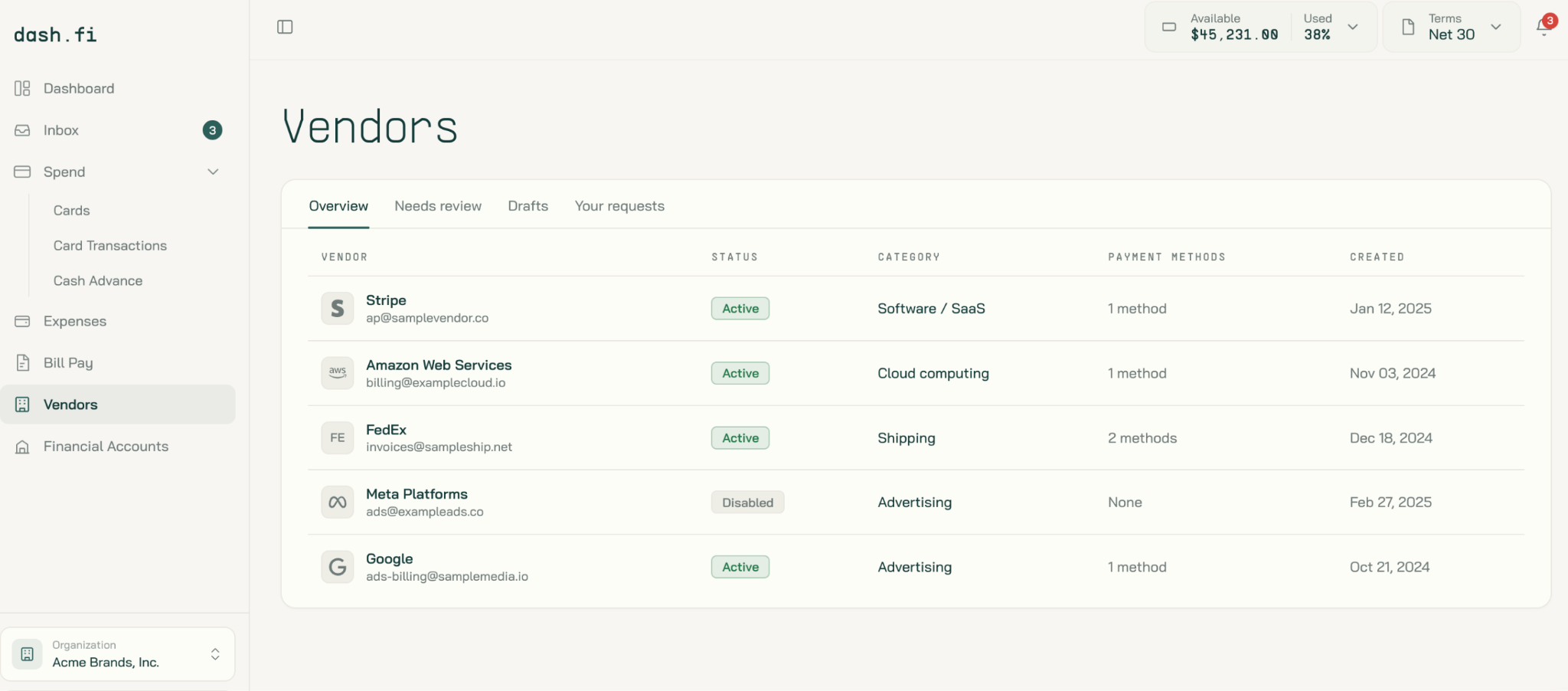
While traditional corporate or personal cards are built for general business expenses and top out at 1% or 1.5% cashback, media-specific infrastructure provides premium rewards reaching up to 3% on critical high-spend categories like digital ads and shipping.
Transitioning away from generic corporate banking products captures an immediate, predictable cash delta that can be immediately routed back to your working budget.
Automated Audits and the Reality of Network Fraud
When a brand relies on automated network routing, it opens itself up to significant waste from bots and spam accounts.
To eliminate this blind spot without adding manual overhead, enterprise teams pair their card architecture with Dash.fi's second core offering: their Ad Pay Protection service. This defense system utilizes an automated tracking pixel embedded in your website's header to independently monitor traffic quality in real time.
Here’s a snapshot of how shifting from a legacy manual auditing process to an automated infrastructure transforms your ad pay protections:
Once this pool of trapped capital is recovered and flowing back into your ad accounts, the last challenge is translating these operational efficiencies into a language that wins over your CFO.
How to Turn Ad Waste Into CFO Approval
Affiliate leaders frequently struggle to secure more budget because finance teams look at partner programs through a strict cost lens. To win over a CFO, an affiliate manager must shift the conversation to margin efficiency.
As Bell plainly puts it: "Your CFO just cares about what the overall savings are going to be."
When moving from a standard corporate card to a specialized media card, a consistent 1.5% to 2% cash-back creates a predictable injection of new capital. Affiliate managers can present this strategy to the finance team as a self-funding mechanism.
By capturing the 3% to 6% waste from invalid traffic alongside the higher card rebates, the marketing department either increases the total working budget or routes the savings to the bottom line to improve profitability.
This dual-action recovery changes the internal narrative entirely. Rather than pitching a speculative budget increase, affiliate managers can show the CFO a tangible pool of recovered capital that completely self-funds expansion without increasing liabilities.
Transforming Ad Infrastructure Into a Revenue Driver
Years ago, buying 50-cent leads on Meta or Google made it easy to turn a $100 ad spend into $5,000 in revenue. Today, you’re often grinding it out just to break even.
When margins are this tight, you have to hunt down advantages anywhere you can find them.
As ad networks force more automation and kill off reporting transparency, treating your payment workflows as an afterthought is a massive risk.
The endless cycle of begging leadership for an extra sliver of marketing budget ends when you plug the leaks hiding in plain sight. Upgrading your financial infrastructure turns what used to be a pure cost center into a direct revenue engine. When you combine automated traffic monitoring with premium card rebates, your budget gets bigger, cleaner, and significantly more productive.
The takeaway? You shouldn’t treat your ad accounts like a just another set-it-and-forget-it line item—especially when you have the tools at your disposal to funnel those recovered savings straight into your partner programs.
