
How to Build a High-Yield Partner Pipeline on LinkedIn (Without Sending a Single Cold Email)


Why Potential Partners on LinkedIn Are Deleting Your Outbound Sequence
The traditional playbook for scaling an advertiser program is showing its age.
For years, performance marketers relied on a predictable, automated loop: scrape a database, build a list of potential publishers, and launch a cold email sequence.
But as inboxes face unprecedented noise and security filters tighten, more of those cold messages are ending up in the spam folder than ever before.
When your entire outreach strategy relies on the same channels that your potential partners are actively avoiding, your competitive edge disappears.
To build a resilient affiliate program, advertisers should stop chasing low-intent lists and meet high-value partners where they’re actually doing business. That channel is LinkedIn.
We studied the strategy of Zach Measures, Everflow’s Commercial Director EMEA, to understand how to execute this shift. Zach has moved away from cold automation to build a highly lucrative, relationship-driven pipeline on LinkedIn. This Masterclass dissects his framework for turning passive social feeds into a proven system for partner acquisition.
Migrating From Dead Inboxes to Active Feeds
Cold email outreach no longer commands the attention it once did. Top-tier partners rarely respond to unsolicited automated sequences, leaving teams struggling to hit recruitment targets.
Yes, potential partners still want to build profitable business relationships. That said, reaching them requires showing up where they’re already paying attention. Zach emphasizes that the sheer volume of daily digital clutter forces a shift in how performance marketers initiate contact:
Moving outreach to LinkedIn completely changes the dynamic of your first contact. Your message arrives alongside your professional history, allowing your profile to provide instant validation of your brand credibility.
Treating LinkedIn as a direct sales pipeline rather than a passive channel allows advertisers to scale outreach via conversations that feel natural, relevant, and timely.
Rethinking the Ideal Partner Profile Through Tangential Connections
When advertisers look for new partners, they often limit their searches to traditional affiliates or direct industry publishers.
But this narrow focus creates intense competition for a small pool of known actors.
A more strategic approach involves identifying tangential professionals who already hold trust-based relationships with your ideal corporate customers. That’s why you should focus your discovery and outreach on three key profiles:
- Sales professionals at companies who already sell to your target audience
- B2B agency operators who manage accounts and tech stacks within your niche
- Non-competing industry peers who hold established relationships with your target decision-makers
Because these tangential professionals are already speaking directly to your target audience, they serve as excellent referral sources. By building structured referral incentives for them, you can source high-quality customer leads that traditional affiliate lists miss entirely.
This is where LinkedIn functions as a sort of mapping tool. Instead of sending generic blind pitches, you can visually track shared networks and see which prospects your tangential partners already know.
Treating Your LinkedIn Profile Like a High-Converting Landing Page
When you reach out to a potential partner, the first thing they do is click on your personal profile. If your profile looks like a generic corporate resume, they’ll quickly move on.
Zach curates his own profile as a live blueprint for this strategy. Stripped of corporate fluff, his page acts as an active hub for real-time industry commentary and tactical insights. By consistently sharing his personal and professional observations, Zach proves to prospective partners that he is an active, deeply knowledgeable operator in his niche.
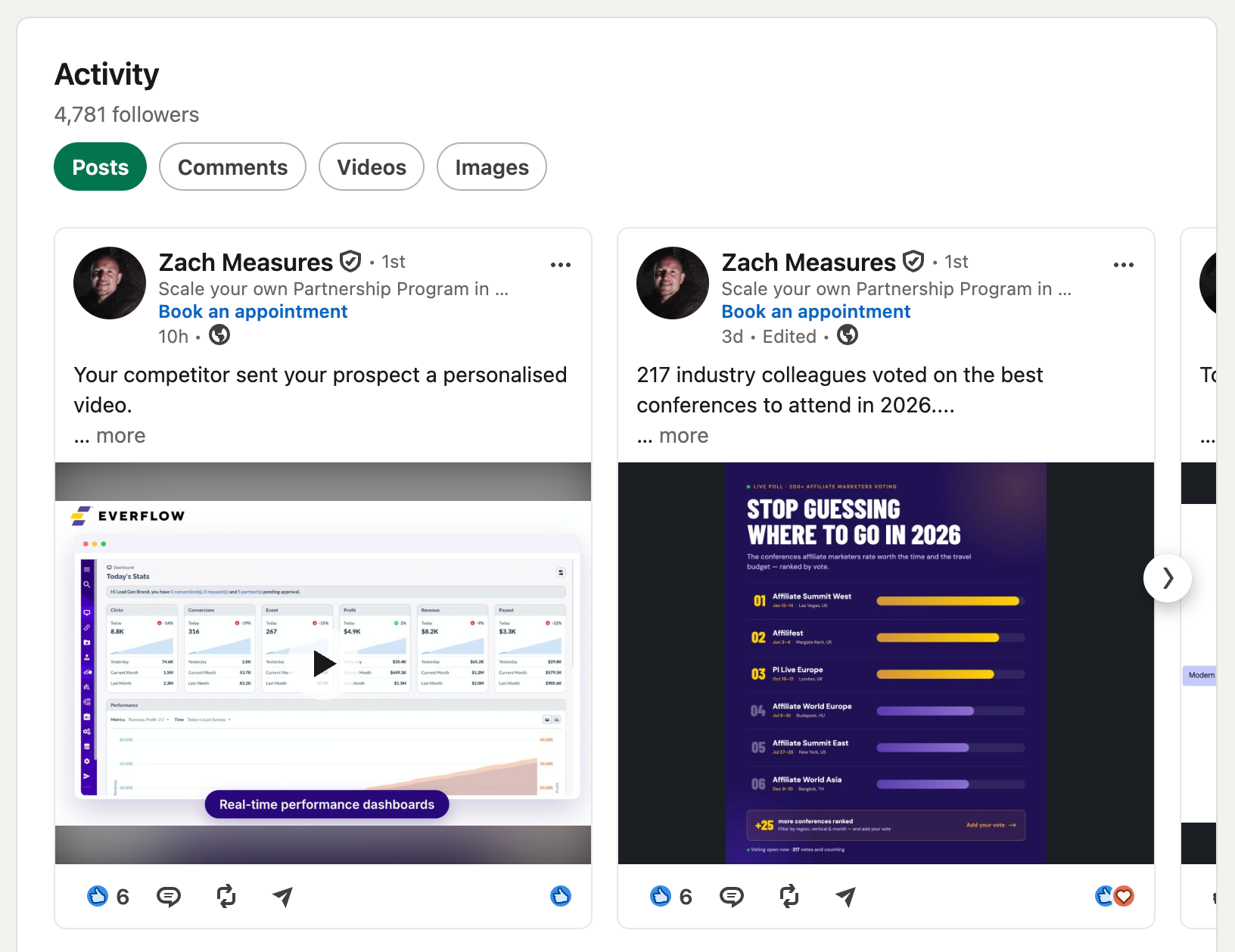
Performance marketers must optimize what Zach calls their personal "shop window" to convert passive partner curiosity into structured business discussions. Maximizing this conversion requires focusing on two strategic priorities:
- Clarify Your Core Value Proposition: Your profile header and summary must state exactly what problem you solve and how you help your partners succeed using plain, jargon-free language.
- Optimize Your Featured Content: Use the featured section of your profile to display concrete resources, such as link booking tools, recent case studies, or actionable frameworks, to provide immediate utility to visiting professionals.
Zach puts this directly into practice by anchoring his own "Featured" section with high-value, functional tools like his custom Model Context Protocol (MCP) Prompt Library for Agencies. This proves he practices what he preaches while serving as an immediate tool for visitors.
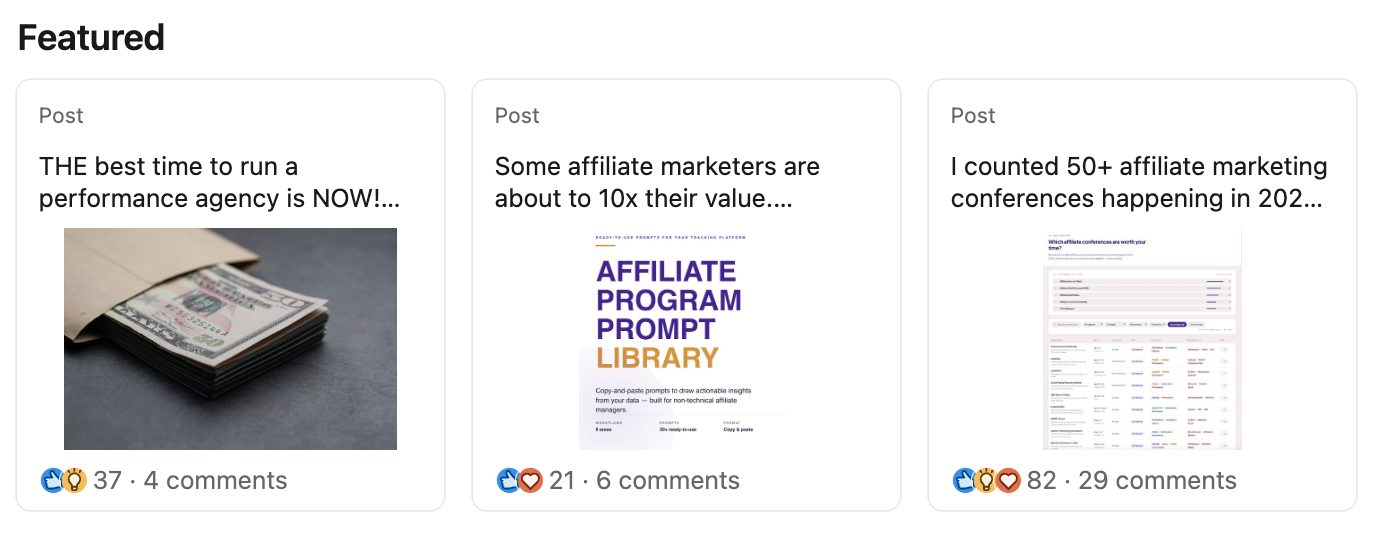
Pinning functional tools to your page establishes authority right out of the gate, transforming your profile from a static resume into an active asset that solves real-world partner problems.
Start Building Evergreen Tools (and Stop Posting AI Slop)
Generative AI has flooded LinkedIn with low-effort content.
LinkedIn posts that offer no new perspectives or unique data hurt your personal brand and get ignored by industry professionals. Because top-tier partners know slop when they see it.
That’s why Zach focuses on building practical tools that solve real industry problems. For example, he recently used accessible development tools to create a directory of global affiliate marketing conferences to solve a personal challenge: keeping track of essential industry events.
This approach perfectly highlights the distinct line between the right and wrong ways to leverage AI for partner recruitment on LinkedIn:
Offering a practical tool completely reframes your outreach, turning a standard sales pitch into a genuine professional resource. Performance marketers can track how targets interact with these assets by utilizing Sales Navigator SmartLinks to monitor return visits and session lengths.
When you see a high-value prospect repeatedly opening a directory or framework you built, you gain a natural reason to open a direct dialogue or catch up at your next industry event.
Don’t Get Discouraged by Vanity Metrics
Many marketing teams get distracted by vanity metrics like impressions and post likes. They assume a post with hundreds of reactions is successful, while a “quiet” post is a failure.
But Zach says this assumption is often incorrect in the world of B2B partner recruitment.
Content that speaks directly to a small, highly-specialized group of decision-makers rarely goes viral. A post detailing a specific technical integration or a niche workflow might only receive a dozen likes. However, its business value is significantly higher than a generic viral post.
Consider Zach's experience launching his MCP prompt library designed specifically for agencies to connect AI agents to their client accounts. On the surface, his LinkedIn post generated a handful of likes and comments.
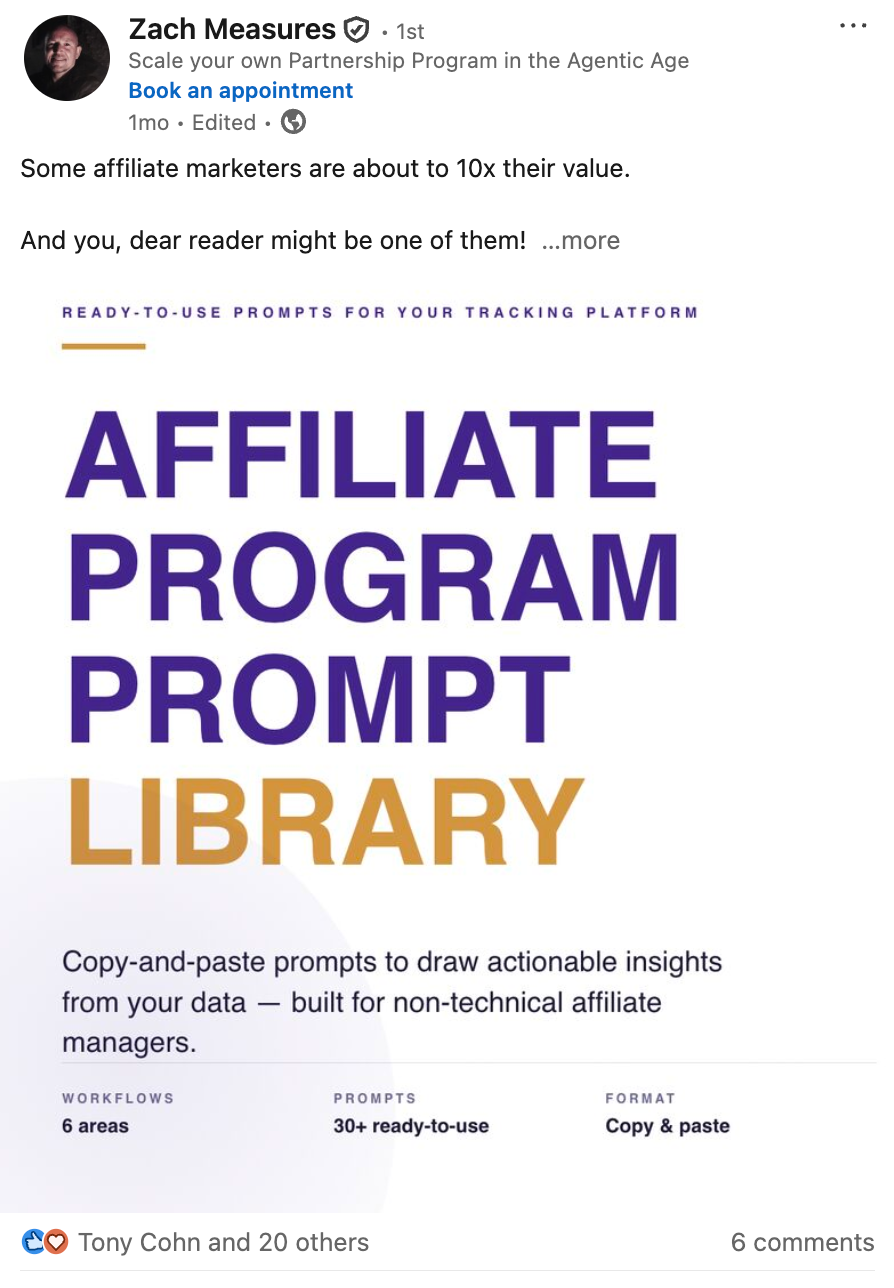
By standard benchmarks, the post did “okay.” On the backend, that single resource directly booked three meetings with executives who needed that exact solution.
High-value partners typically consume content silently. They rarely interact publicly through likes or comments, but they will reach out directly when a resource solves a distinct bottleneck. Shift your primary goal away from public applause and focus entirely on private calendar bookings.
Lead With a Tool (Not a Calendar Link) on LinkedIn
Advertisers can’t expect busy professionals to care about their internal program goals. To cut through the noise, your outreach must lead with immediate, undeniable value.
And that’s why partner recruitment requires a shift from traditional, transactional outreach to authentic asset creation.
Whether you are building a custom directory or offering a streamlined tracking setup, your content must serve as a practical solution. When you consistently solve small problems for your target audience, you build the trust required to solve larger business challenges together.
That’s how you turn passive browsers into long-term program partners.
